
Intelligence Brief
•12/08/2026
Cultivate Intelligence Brief · Issue 03 · August 2026
In Issue 02 we wrote that the ocean had entered its delivery era, with journalists starting to audit the Mombasa pledges. This month the same scrutiny reached land, just as a restoration story with real momentum was building, days out from the land community’s biggest fortnight in years. UNCCD COP17 opens in Ulaanbaatar on 17 August.
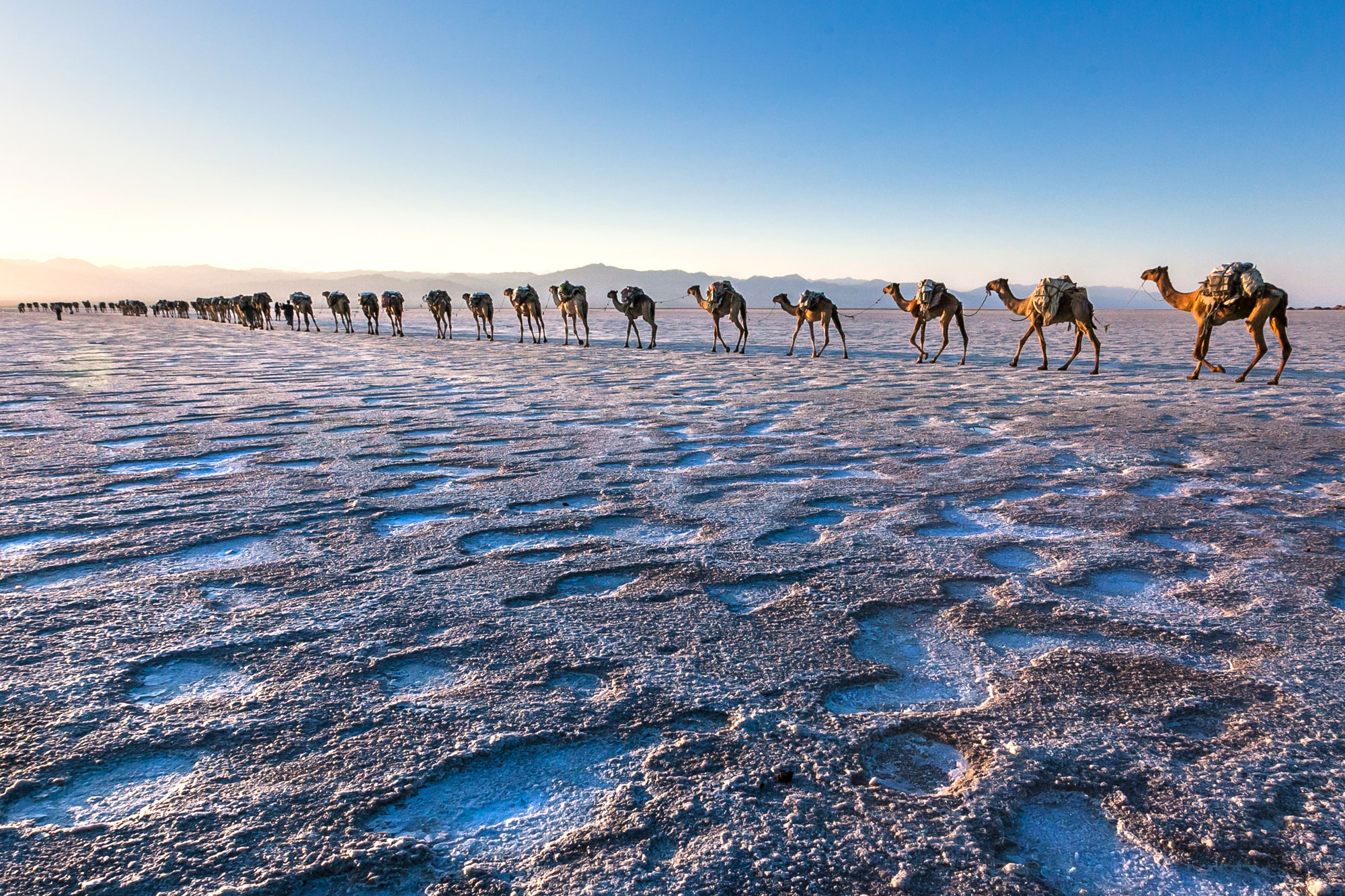
Camel caravan sunset over Dallol salt flats
The land and desertification conversation spent July underground. Nothing drew more coverage this month than soil itself, its biology and its carbon. The most widely syndicated science story of the month was the first global map of arbuscular mycorrhizal fungal networks, published in Science by the Society for the Protection of Underground Networks (SPUN) and partners: an estimated 110 quadrillion kilometres of fungal filament threading the world's topsoil and moving roughly four billion tonnes of carbon dioxide equivalent into the ground each year. Lead author Dr Justin Stewart's description travelled furthest: up to ten metres of fungal network in a teaspoon of soil.
One of the most engaged LinkedIn posts of the month called land degradation "the hidden climate crisis": the problem underneath food security, water stress and climate itself, running on a fraction of their attention.
Most of this coverage is published from newsrooms and platforms in the United States, India and the United Kingdom, a long way from the Sahel, the Horn of Africa and the drylands where the stakes concentrate.
Restoration is carrying the conversation
What distinguishes this month's coverage from the crisis reporting that usually attends this sector is that the loudest stories are about repair.
The Great Green Wall dominated the feature coverage. Launched by the African Union in 2007 as an 8,000 kilometre belt of trees from Senegal to Djibouti, it has grown into something far broader: a restoration programme aiming to restore 100 million hectares and create 10 million green jobs by 2030, with an estimated US$33 billion price tag. UNCCD's own five-year assessment of the Great Green Wall Accelerator, released this month, reports real progress on restoration, jobs and resilience across the Sahel, and is frank about the distance between financial commitments and results on the ground. Feature writers from The Economic Times to the Times of India spent July telling the hopeful version: a green belt rising against the desert, water coming back to farmland through ancient techniques. The money is organising behind it too, with FAO and the Green Climate Fund launching the US$222 million SURAGGWA programme across eight Sahelian countries in December.
The restoration story also travels with hardware. The most engaged LinkedIn post of the month showed China's solar-powered tree-planting robots greening desert.
UNCCD Executive Secretary Dr Yasmine Fouad, whose pre-COP interviews ran everywhere from The Diplomat to Xinhua in July, framed the stakes the same way: "The hope COP17 must restore is confidence that degradation can be reversed."
What surprised us most this month
The people of the drylands started getting named. Rangelands and pastoralists have long been the least visible constituency in the least visible crisis, and this year, the UN International Year of Rangelands and Pastoralists, they are climbing steadily into the coverage. Fouad's own numbers set the scale: rangelands support around two billion people and provide nearly 70 per cent of the world's livestock feed, yet up to half are degraded or at risk. Kenya hosted this year's World Desertification and Drought Day under the theme "Rangelands: Recognise, Respect, Restore". And on 11 August, Nigeria's environment minister Balarabe Lawal warned that the country's 650,000 square kilometres of rangelands, and the pastoral livelihoods on them, are being eaten away by degradation and overgrazing.
The BBC found the story's most affecting form: camels, the animals built for the desert, dying of heat. Afar herder Ali Umer described losing eight calves in a month, and FAO camel health scientist Dr Mohammed Bengoumi confirmed the pattern across a Sahara where summers now regularly pass 50 degrees. It was the month's biggest mainstream land story, and at its heart it is a pastoralism story.
Where the institutional case is being made
UNCCD owned the month, from Fouad's interview circuit to deepened land restoration cooperation with China. FAO anchored both the finance story and the science of pastoral livestock health. The Wildlife Conservation Society is bringing its conservation science to COP17, IUCN launched a five-year biodiversity roadmap with Libya, UNDP is backing new sustainable land management investment in Eritrea, and UNESCO carried Kenya's renewed rangeland commitments on the road to Mongolia. On LinkedIn, the research-for-development community showed its practical edge: a new crop-suitability tool for farmers and extension workers was among the month's most engaged posts.
The fortnight in Ulaanbaatar
COP17 runs 17 to 28 August under the theme "Restoring Land, Restoring Hope", with 197 Parties convening in Mongolia. It is the first of 2026's three Rio convention COPs, with biodiversity (CBD) and climate (COP31) to follow later in the year, making August the opening move in a five-month global negotiation season. The agenda Fouad has signalled: mobilising restoration investment, drought preparedness (droughts have grown nearly 30 per cent more frequent and longer since 2000), and overdue attention to rangelands and pastoralists. The COP17 youth statement is open for inputs now.
Degradation already affects up to 40 per cent of the world's land, and for two weeks in August it holds the global spotlight.
What we'd be doing now
Put a land line in your organisation's story before 17 August: whatever your mission touches, land sits underneath it. Draft the sentence that articulates that connection now and use it in pitches and briefings while COP17 holds the spotlight.
Bookmark the fungal map: SPUN's mycorrhizal map is the rare asset that makes soil visible and scientific in one image. It gives any communicator a way into the "land as living infrastructure" framing without waiting for a policy hook.
Plan one narrative across three COPs: desertification, biodiversity and climate negotiate in sequence this year, and the same restoration story can be told at each. Log what COP17 produces in August and bank it for the CBD and COP31 moments.
The pattern beyond land: the delivery audit we described in Issue 02 has crossed sectors on schedule, with Great Green Wall coverage now leading on the US$33 billion question of what has actually been restored. And on LinkedIn, Europe's brutal fire summer kept bending back towards land, with one widely shared post arguing that "Europe needs forests, not just air conditioners".
About the Cultivate Intelligence Brief
A monthly strategic review and forecast of one sector: what shifted in the past month, what is coming in the next, and the communication opportunities around it. Each issue reads three layers of the media landscape: mainstream reach, sector prominence and LinkedIn community conversation. It begins with a guided, AI-powered analysis of thousands of global news stories and social media posts. We extract the narratives and sector developments that matter, then identify the opportunities to shift the conversation. This issue took on land and desertification. Future issues will focus on other sectors as they move. If a brief like this on your own thematic focus, configured to your organisation, geographies and stakeholder landscape, would be useful, that is what Cultivate Intelligence can do.
About the authors
The Cultivate Intelligence Brief is written by Samuel Stacey and Holly Holmes, co-founders of Cultivate Communications®. Samuel and Holly are communications specialists working with mission-driven organisations across food systems, climate, environment, health and international development. Through Cultivate, they help research organisations, NGOs and purpose-led institutions turn complex ideas into clear strategy, stronger positioning and communications that reach the audiences that matter.
